



Integrating gender into climate-neutral mobility: Lessons from the Trikala Living Lab
- Feb 19
- 4 min read
As cities across Europe accelerate the transition to climate-neutral mobility, a key question is gaining urgency: Who benefits from these changes and who risks being left behind?
New insights from the ELABORATOR project’s Living Lab in Trikala, Greece, show that ensuring sustainable mobility is not only a technological challenge, but also a social one. By combining gender analysis, participatory research, and smart mobility innovation, the Trikala pilot is helping reshape how cities plan for inclusive, climate-neutral transport systems.
Understanding everyday mobility through a gender lens
A defining feature of the Trikala Living Lab is its participatory approach.
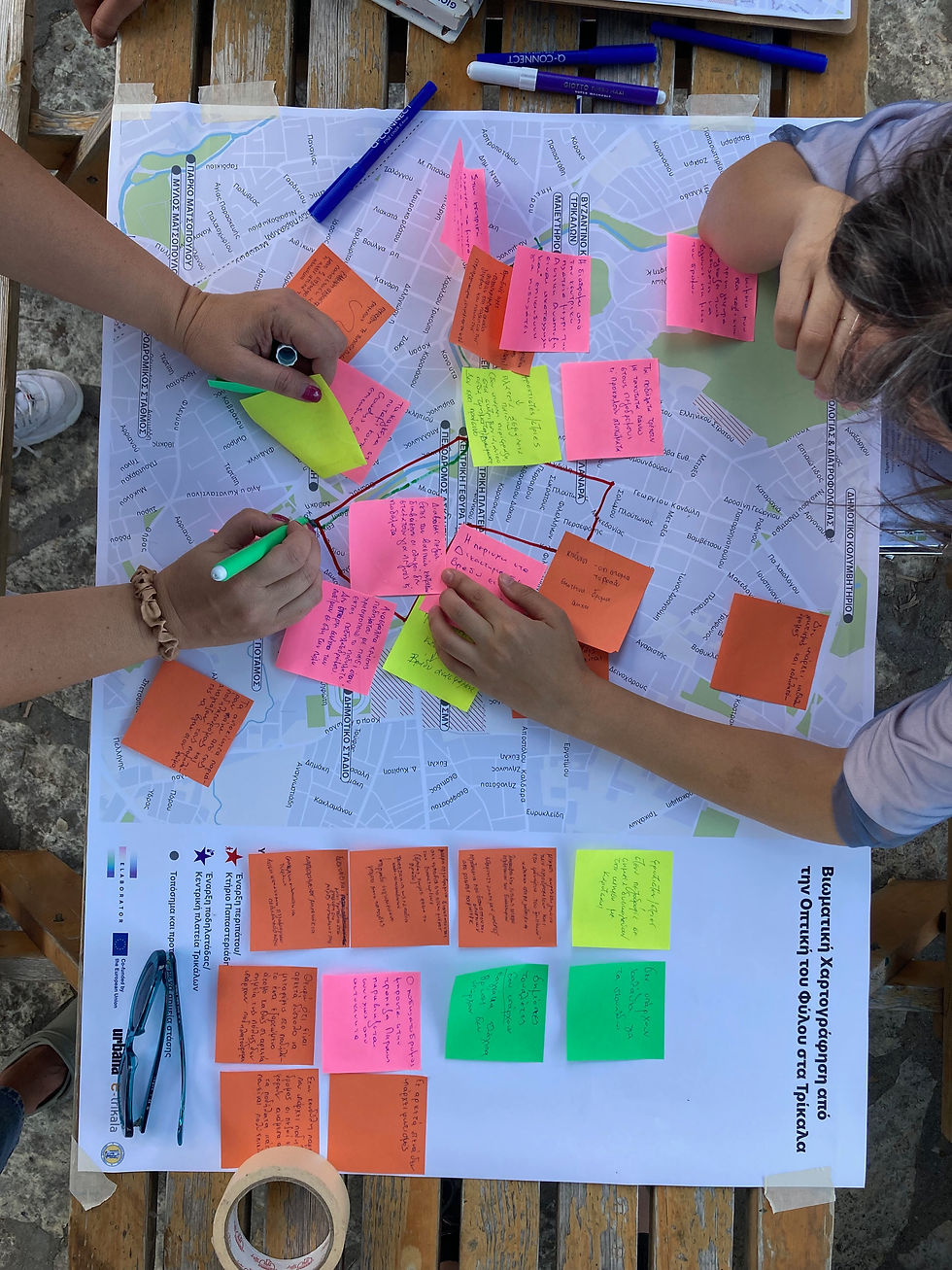
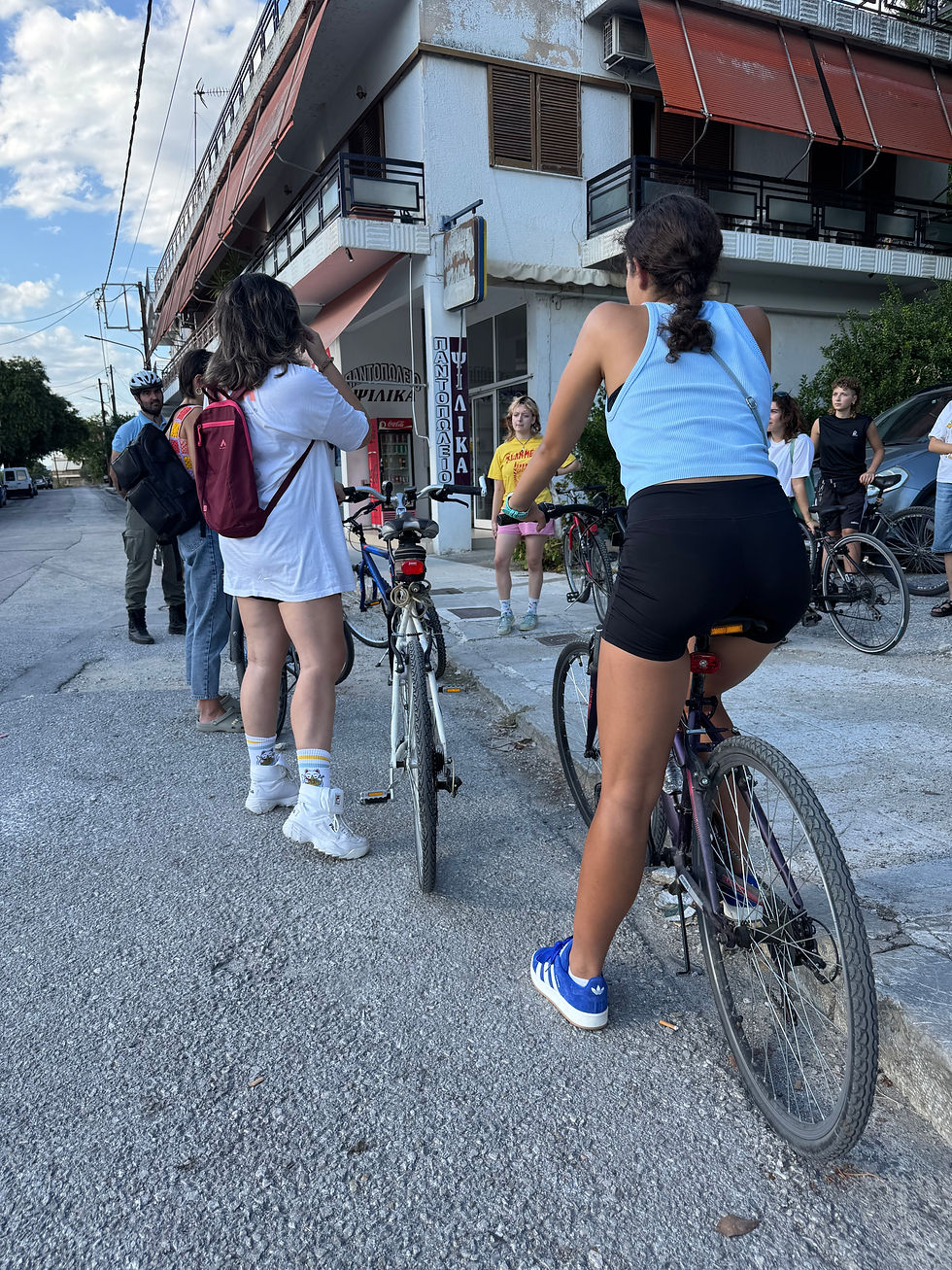
Women from diverse backgrounds, including caregivers, younger residents, and rural populations, took part in exploratory walks, cycling assessments, mapping exercises, and co-analysis workshops.
These activities positioned participants as co-researchers, enabling them to identify barriers, share lived experiences, and propose solutions directly to planners and local authorities.
The research conducted in Trikala reveals that women’s daily mobility patterns differ significantly from the assumptions underpinning conventional transport planning.
Survey findings show that nearly half of women’s daily trips are linked to caregiving responsibilities: escorting children, supporting older relatives, shopping for households, or managing administrative tasks.
These journeys are rarely linear. Instead, they involve complex “trip chains” with multiple stops, tight time schedules, and diverse destinations.
Such patterns are difficult to accommodate within mobility systems designed primarily around peak-hour commuting.
The research also highlights how caregiving responsibilities shape transport choices. Many women reported that walking, cycling, or public transport turned out to be impractical when travelling with children, groceries, or dependents, reinforcing reliance on private cars, often out of necessity rather than preference.
Car dependence and rural mobility gaps
Car use thus remains high among women in Trikala, particularly for those living in suburban and rural areas. Limited public transport services, infrequent routes, and poor connectivity between villages and the city centre make private vehicles the only viable option for many essential trips.
For older women without driving licences, this creates structural dependence on relatives—often male family members—for access to healthcare, services, and social activities.
Participatory workshops with women from surrounding villages mapped long, multi-purpose journeys into the city, revealing emotional barriers in addition to logistical ones: anxiety, stress, and fear linked to unsafe road conditions and poor lighting along rural-urban routes.
Safety concerns shape mobility choices
Safety emerged as one of the most influential factors shaping women’s mobility
decisions.
Many participants reported altering routes, avoiding specific streets, or limiting travel at night due to fear of harassment or violence. Even in a medium-sized city like Trikala, insecurity affects whether women feel able to move freely and independently.
Workshops and interviews highlighted how safety is shaped by both infrastructure and social dynamics: from poorly lit streets and obstructed sidewalks to male-dominated public spaces and low evening activity in certain districts.
These “emotional geographies” influence not only how women travel, but whether they choose sustainable modes at all.
Walkability and cycling: potential and barriers
Trikala’s flat terrain and compact urban form create strong potential for active mobility.
However, participatory walk audits and cycling tours revealed persistent micro-barriers that limit uptake:
Narrow or obstructed sidewalks
Discontinuous cycling lanes
Illegal parking on pedestrian and bike routes
Lack of ramps, seating, or shading
While younger women often described cycling as empowering, caregivers noted that fragmented infrastructure and traffic risks make it difficult to combine cycling with care-related trips.
These findings underline the importance of designing networks that reflect real travel behaviour, not idealised user models.
Smart technologies supporting inclusive mobility
Alongside participatory research, Trikala is piloting digital and data-driven mobility innovations, including:
Smart pedestrian crossings near schools
Sensors detecting illegal parking in cycling lanes
Infrastructure monitoring to identify safety risks
A multimodal journey-planning mobility app
These tools use real-time data to enhance safety and accessibility while supporting low-emission travel choices.
Crucially, they are being developed alongside social inclusion strategies.
From Local Insights to Lasting Change

Findings from the Trikala pilot are already feeding directly into local planning and policy development, helping shape a more inclusive approach to climate-neutral mobility.
Priorities emerging from the research include:
Improving the safety and continuity of walking and cycling networks
Upgrading lighting across both urban and rural areas
Strengthening public transport frequency and reliability
Stronger enforcement of traffic and parking regulations
All of this needs to be embedded within a gender-mainstreamed revision of the city’s Sustainable Urban Mobility Plan (SUMP).
By institutionalising participatory methods within long-term governance, Trikala aims to ensure that inclusive mobility remains a structural priority beyond the project’s lifetime. More broadly, the Living Lab demonstrates that gender-sensitive planning is not an add-on to climate action but a prerequisite for its success: when mobility systems reflect the realities of caregiving, safety, accessibility, and rural connectivity, they work better for everyone.
As ELABORATOR scales its lessons across Europe, Trikala stands as a powerful example of how community insight, technological innovation, and inclusive planning can come together to drive a truly just transition to climate-neutral urban mobility.
Final remarks
The papers that were used as sources of this article will be presented in the upcoming months at the Transport Research Arena (TRA), hosted in Budapest on 18-21 May 2026 and at the Conference on Sustainable Mobility (CsuM), hosted in Skyros Island, Greece, on 1–3 July 2026.
More information on the CSuM special session dedicated to the ELABORATOR partners is available here, and you can consult the TRA programme here.
Stay tuned for more ELABORATOR updates!


